The Language of Colour
How the colours you’re instinctively drawn to can shape the way you meditate
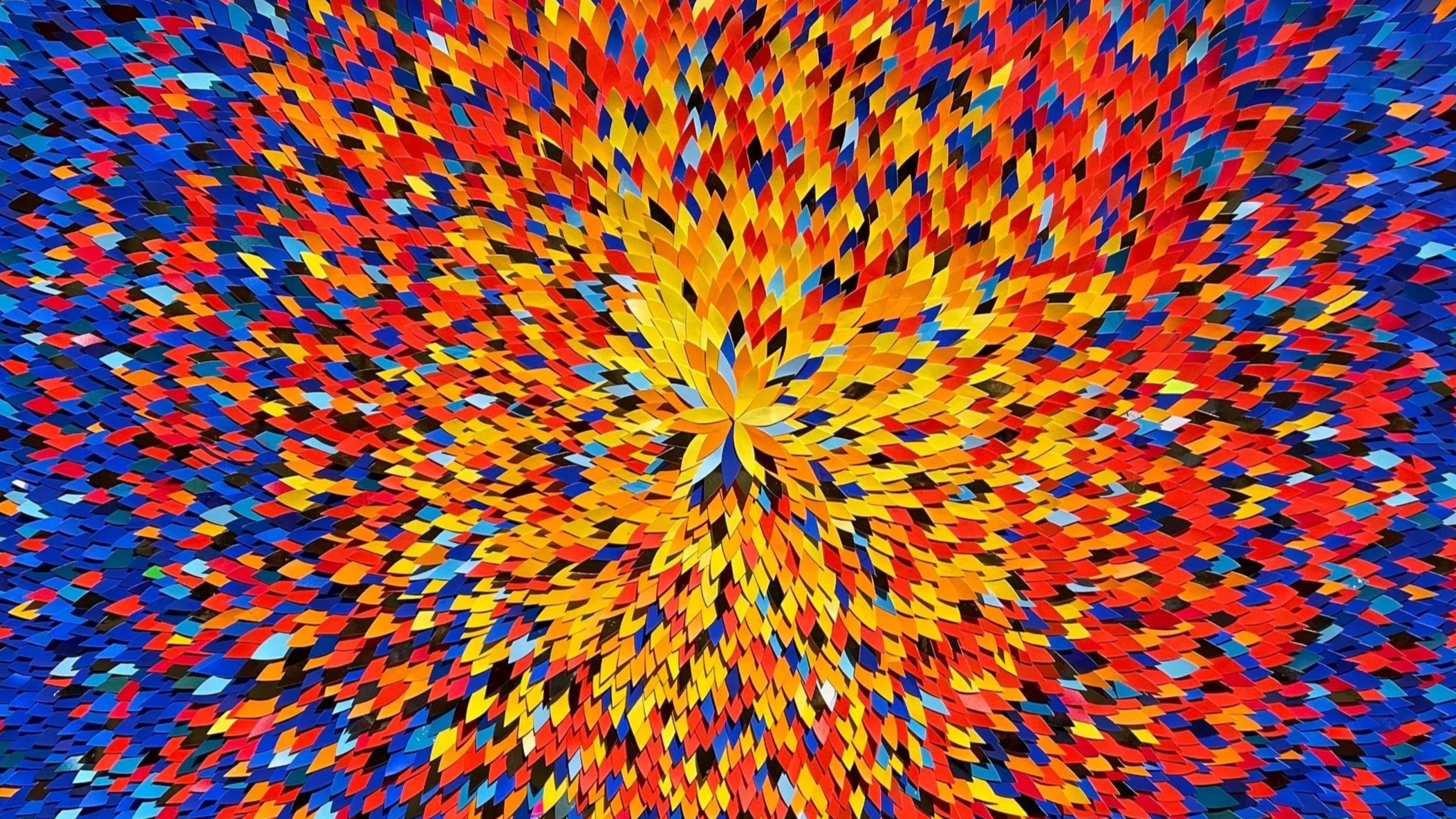
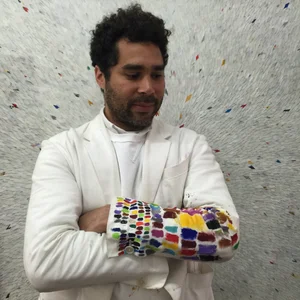
‘In colour’ by Robi Walters
This month, millions of people across the world celebrated the Hindu festival of colours Holi, which dates back over two thousand years. On the morning of the festival, streets fill with clouds of coloured powder called gulal and for one day, every social boundary dissolves. The tradition comes from the story of Krishna and Radha: Krishna, whose skin was dark blue, worried that fair-skinned Radha wouldn’t love him. His mother told him to go and colour Radha’s face in any shade she chose. She did, and they became inseparable.
What’s beautiful about Holi is that it doesn’t treat colour as decoration. It treats colour as a force, something that can shift energy, dissolve difference, and mark a new beginning.
That instinct runs deep. Colour is vibration — light moving at different speeds. And it affects us not just visually, but physically too. Research published in the Annual Review of Psychology confirms that colour perception influences affect, cognition, and behaviour in measurable ways. Studies at the University of Leeds found that red light raised pulse rate compared to blue and green light, while a 2020 study of 120 participants using coloured lenses found that red significantly increased both blood pressure and heart rate, while blue and green had the opposite effect.
This is exactly why the ancient chakra system, which comes from the same tradition as Holi, maps seven colours to seven energy centres in the body. Each colour holds something different.
The seven colours and what they hold
Red · Root
Grounding, safety, physical presence. The base of the spine. In Holi, red is the most sacred powder, placed on deities as a mark of protection. If you’re drawn to red, you may be craving stability. A meditation that starts with your feet flat on the floor, visualising warmth at the base of your spine, could anchor you faster than trying to empty your mind in silence.
Orange · Sacral
Creativity, sensation, emotional flow. Just below the navel. The colour of saffron robes represent renunciation and the transformative power of fire. If orange pulls you in, your practice may benefit from movement and sensory richness. Try breathing into the lower belly with slow, wave-like rhythm, or pair meditation with sound.
Yellow · Solar Plexus
Confidence, personal power, inner warmth. The upper abdomen. In India, yellow is the colour of turmeric that is used in both medicine and ceremony. If you gravitate towards yellow, you may need a practice with direction. Visualise a ball of golden light in your upper abdomen growing brighter with each inhale. This builds inner authority, which you may find especially useful before a big day or decision.
Green · Heart
Compassion, connection, renewal. The centre of the chest. Green is spring itself, new beginnings after winter. If you keep choosing green, a heart-centred meditation may be the thing that finally makes your practice feel like yours. Place a hand on your chest, breathe into the space, and visualise soft green light expanding outward with each exhale, then draw it back in. This practice is about receiving as much as giving.
Blue · Throat
Communication, truth, clarity. Blue is Krishna’s colour of sky and ocean, something boundless. If blue draws you in, your practice might deepen through sound. Try humming softly on each exhale and feel the vibration at your throat. Visualise clear blue light there, like sky reflected in still water. Sound healing sessions with crystal bowls are deeply resonant for this energy centre.
Indigo · Third Eye
Intuition, inner knowing. The space between the eyebrows. Indigo sits at the edge of visible light, just as intuition sits at the edge of conscious thought. If indigo resonates, try meditating in a dim room with your attention resting gently between the eyebrows. Don’t try to see anything, just notice what arrives. This is a practice that strengthens the instinct you already rely on.
Violet · Crown
Stillness, spiritual connection, wholeness. The crown of the head. The colour most people report seeing during deep meditation. If violet speaks to you, try sitting in complete silence — no music, no guidance, just breath. Visualise a soft violet light at the top of your head, like a door opening upward. This is a practice of surrender: letting go of control and allowing stillness to find you.
What does your colour say about your meditation?
A short quiz that connects your colour instincts to the chakra system and gives you a personalised meditation to try. Takes two minutes.
Sources
Elliot, A.J. & Maier, M.A. (2014). “Color Psychology: Effects of Perceiving Color on Psychological Functioning in Humans.” Annual Review of Psychology, 65, 95–120.
Lee, S. & Westland, S. (2015). “Does Colour Really Affect Pulse Rate and Blood Pressure?” University of Leeds, presented at AIC 2015.
Susanto, R. et al. (2020). “Effect of Blue, Red and Green Colors on Blood Pressure and Heart Rate.” International Journal of Pharmaceutical Research, 12(1), 893–895.
Westland, S. (2017). “Does Colour Really Affect Our Mind and Body?” The Conversation.
Britannica. “Holi: Festival of Colors.” Encyclopaedia Britannica.
History.com. “Holi: Origins, Mythology & Traditions.” HISTORY.
Smithsonian Magazine. “The Meaning Behind the Many Colors of India’s Holi Festival.”
Mindvalley. “The 7 Chakra Colors: Meanings, Symbolism & Activation.”
Sensational Color. “Chakra Colors: Ancient Wisdom Meets Modern Color Psychology.”
The chakra system as referenced here draws on the Vedic and Tantric traditions as described in classical texts including the Sat-Cakra-Nirupana (16th century) and Woodroffe, J. (1919). The Serpent Power.